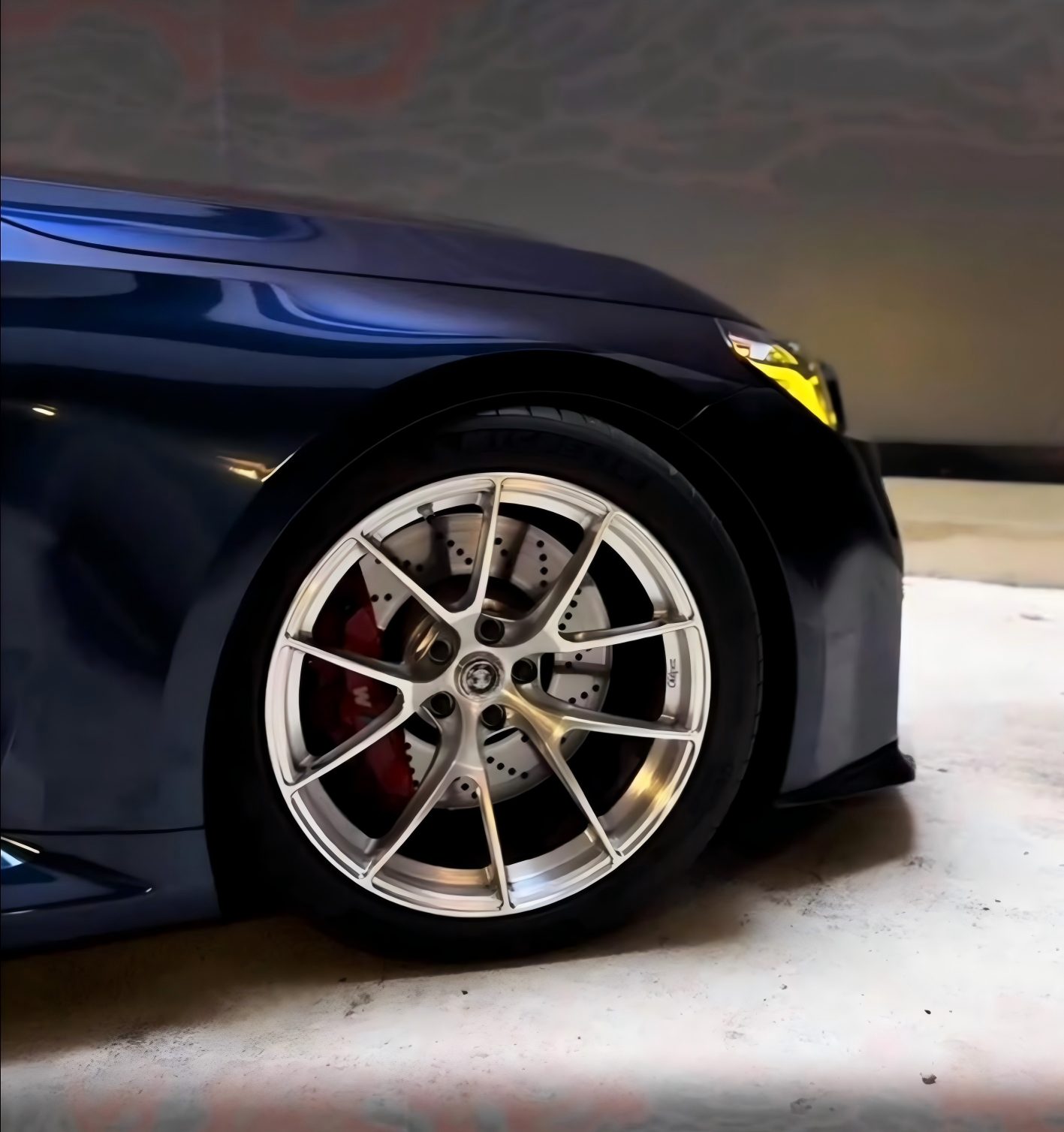
Why a drag wheel is designed for torque rather than cornering, how rim screws and bead seats keep a slick in place, and which specification details decide whether a launch is repeatable.
Drag forged wheels are built for a load case that looks nothing like circuit racing. There is almost no sustained lateral force and there is an enormous longitudinal one: engine torque multiplied through a low first gear, delivered in a fraction of a second, through a tyre that is deliberately soft and a wheel that has to transmit all of it without slipping on the bead or distorting at the hub.
The second difference is the tyre. A drag slick or radial is designed to deform and grow at speed, and its sidewall is stiff in a way that a road tyre's is not. That stiff sidewall transmits launch torque into the bead seat far more directly, which is why a drag wheel needs a different bead retention strategy and a thicker flange than a road wheel of the same size.
The third is the vehicle. A drag car is often lightened dramatically, runs a solid axle or a heavily modified rear suspension, and may lift the front wheels off the line. The rear wheel therefore sees a vertical unloading and reloading cycle that no road car produces, and the front wheel has to survive a landing rather than a corner.
This article covers the structural logic of a drag wheel, the retention hardware that keeps a slick located, the dimensional choices that affect gearing and sidewall behaviour, the safety requirements that apply in sanctioned categories, and the inspection points that belong in a programme where every run is a maximum-effort event.
The Load Case: Torque, Not Cornering
The dominant load on a drag wheel is torsional. Engine torque arrives through the driveline as a sudden rotational impulse, and the wheel has to pass it into the tyre without allowing relative movement at the bead. That impulse is repeated at every launch, and in a test-and-tune session it can occur dozens of times in an afternoon.
The second load is vertical, and it reverses. At launch the rear of the car squats and the front lifts; at the top end the body settles and the front wheel lands. That cycle loads the hub and the spoke in a direction that a cornering-focused design does not optimise, and it is one reason a circuit wheel is not automatically suitable for drag use.
The third is centrifugal growth. A drag tyre grows significantly at speed, and that growth pulls outward on the bead and the flange. A wheel with a thin flange can allow the bead to creep outward under that load, which is precisely the failure that rim screws exist to prevent.
The fourth is brake load, which is smaller than on a circuit car but not zero. A parachute does most of the deceleration at the top end, while the brakes handle the shutdown area and the return road. The wheel still has to transmit that braking torque, and the hub has to stay flat through repeated heat cycles.
How Drag Forged Wheels Handle Launch Torque
The hub is the first line of resistance. A drag wheel typically uses a thicker hub section than a circuit wheel because the torque has to be spread from the bolt circle into the spokes without local yielding. A hub that flexes under launch will eventually loosen its fasteners, and a loose fastener on a drag car is a serious safety matter.
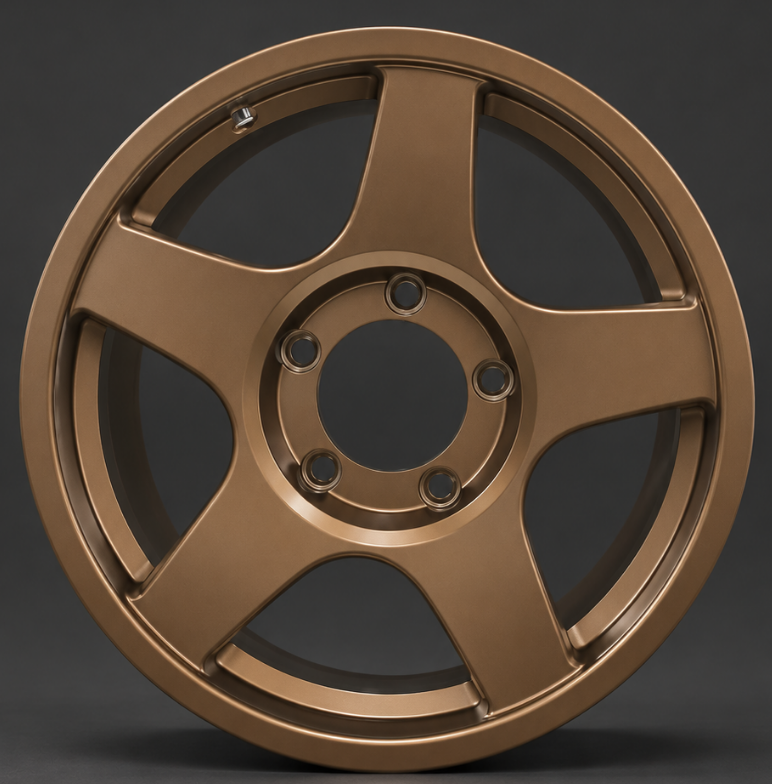
Spoke count is usually low and spoke section is generous. Four or five broad spokes are common because the load is predominantly in one plane and the priority is transmitting torque rather than resisting multi-directional bending. A fine multi-spoke design may look modern but offers no advantage here and adds machining time.
The barrel and flange are the second line. A drag slick seats with a large contact area and generates high local pressure at the bead, so the flange has to be thick enough to resist rolling and the seat has to be machined to a finish that grips without cutting. That combination is what allows the tyre to transmit torque without spinning on the rim.
Forging helps in all three areas because the grain flow runs continuously from hub through spoke into the barrel. Under a torque-dominated load that continuity is exactly what resists crack initiation at the spoke root, which is the point where a drag wheel would otherwise fail first.
What a drag wheel is asked to survive on every run:
- A torque impulse far above steady-state driveline load, delivered in milliseconds
- Vertical unloading and reloading as the car squats and settles
- Centrifugal tyre growth that pulls outward on the bead at the top end
Bead Retention: Screws, Knurling and Clamps
The simplest retention method is a rim screw: a small hardened screw threaded through the flange and into the bead, preventing the tyre from rotating on the rim. It is common in drag racing because it is light, inexpensive and effective, and because it can be inspected easily between runs.
The second method is knurling, where the bead seat surface is given a pattern of fine ridges that increase friction against the tyre. It avoids drilling the flange and it spreads the load over the whole circumference, which is gentler on the tyre bead. The trade is that knurling wears with repeated tyre changes and loses effectiveness gradually.
A functional beadlock is the third and the most secure, but it adds mass at the outer rim, which is the worst place for it on a car where every kilogram matters. It is used where the rules require it or where torque levels are high enough that screws alone are not sufficient.
The retention method has to be specified with the tyre. A screw positioned for one bead profile may sit badly on another, and a screw that is too long can damage the bead wire. The supplier should state the screw size, position and count for the tyre being used, and the buyer should treat that as part of the wheel specification rather than as an accessory.
Diameter, Width and Gearing
Drag wheels are usually small in diameter and wide in section. A smaller diameter allows a taller sidewall for the same overall tyre height, which is what a drag tyre needs in order to deform at launch and grow at speed. It also reduces rotating mass at the rim, which matters more here than on any other kind of car.
Width determines how much of the tyre's tread is supported and how the sidewall sits. A wider rim flattens the tread and increases the contact patch, which helps traction, but it also reduces the sidewall's ability to wrinkle and absorb the launch. The correct width is the one the tyre manufacturer specifies for the intended application, not the widest that will fit.
Overall diameter affects gearing directly. A change of an inch in tyre diameter changes the effective final drive by a few percent, which can be the difference between crossing the line at peak power and crossing it past the power band. That is why drag wheel and tyre choices are made together with the gear ratio rather than independently.
Front and rear are separate specifications. The front wheel carries very little load but has to survive a landing and provide stable steering at speed, so it is usually narrow and light. The rear carries the launch, so it is wide, thick in the hub and reinforced at the flange.
| Specification | Rear Axle | Front Axle |
|---|---|---|
| Primary requirement | Torque transmission and bead retention | Low mass and stability at speed |
| Width | Wide, matched to the slick or radial | Narrow, often 3.5 to 4.5 inches |
| Hub section | Thick, to spread torque into the spokes | Lighter, sized for landing loads |
| Flange | Reinforced, with retention features | Standard, sized for high-speed stability |
| Retention | Screws, knurling or a functional beadlock | Rarely needed |
| Mass priority | Low, but never at the expense of the hub | Lowest possible |
Mass, Inertia and the Launch
On a drag car the value of a kilogram is different from anywhere else. Total mass affects the power-to-weight ratio directly, and rotational mass affects how quickly the engine can accelerate the driveline. Both matter, and both are reduced by choosing a lighter wheel.
The inertia effect is more pronounced in the lower gears, where the wheel and tyre are accelerated hardest. A light rear wheel helps the engine reach its power band more quickly off the line, which is why drag builds often spend disproportionate effort on rear wheel mass and almost none on the front.
There is a limit, and it is structural rather than aerodynamic. The hub and spoke have to carry the launch torque, and a wheel lightened past that point will flex, loosen fasteners and eventually crack. The correct approach is to specify the torque the driveline produces and let the design follow, rather than to specify a target weight and hope the structure keeps up.
Tyre mass should be counted in the same sum. A large drag slick is heavy, and it sits at the outermost radius where inertia is highest. A change of tyre construction can alter the rotating mass more than a change of wheel, which is why the two should be evaluated together.
Safety Requirements in Sanctioned Categories
Sanctioned drag racing applies technical regulations to wheels and fasteners, and those regulations vary between bodies and classes. Some require specific fastener grades for the wheel studs, some require a particular retention method for slicks, and some require that the wheel be listed by a recognised approval body for the class.
A buyer should check the rule book before ordering rather than after, because a wheel that does not comply cannot be used regardless of its quality. That is a conversation to have with the technical inspector early, and it is worth documenting the answer in case the interpretation differs at another event.
Fasteners deserve particular attention. A drag car loads its studs and nuts far beyond road use, and worn or low-grade hardware is a common cause of failure at the line. Studs should be inspected for stretch and replaced at defined intervals rather than when they look worn.
The wheel itself should have a documented load and fatigue test at a rating appropriate to the vehicle. A drag car's static weight may be modest, but the dynamic load at launch and landing is not, and a rating based on the kerb weight alone does not describe the duty.
Inspection Between Rounds
The first check is at the bead. Screws should be seated and undamaged, the bead should show no sign of movement, and the flange should be free of deformation. A tyre that has rotated on the rim leaves a witness mark, and that mark is the earliest indication that retention is marginal.
The second is at the hub. Look for fretting around the bolt holes, a polished ring at the mounting face and any sign that the nuts have been moving. Those marks indicate that the joint is not holding preload, which on a drag car is a warning rather than a cosmetic issue.
The third is at the spoke roots. A visual check under good light after every event, with a closer inspection whenever the wheels are off, will catch the surface indications that precede a crack. Dye penetrant inspection at the end of a season is a reasonable addition for a car running high torque.
The fourth is runout and balance. A drag wheel does not need the same lateral precision as a circuit wheel, but a change in runout between events indicates that something has moved. Balance matters at the top end, where a small imbalance becomes a vibration that unsettles the car.
Tyre Growth and Top-End Stability
A drag tyre grows at speed. The centrifugal force at the tread pushes the carcass outward, and a tall sidewall with a soft compound grows more than a road tyre would. That growth changes the effective diameter, which changes gearing, and it also changes where the tyre sits relative to the rim flange.
The wheel has to accommodate that movement without allowing the bead to creep. A flange that is too shallow gives the bead nowhere to sit as the tyre grows, while one that is too deep adds mass and can interfere with the sidewall. The correct profile is a manufacturer-specific decision that should match the tyre being run.
Balance becomes more important at the top end. A small imbalance that is unnoticeable at road speed produces a vibration at drag speeds that can unsettle the car, and it also loads the hub in a way that is not part of the design case. Balancing the complete assembly with the tyre fitted is the only meaningful check.
Front wheel stability deserves separate attention. A narrow front wheel with a tall tyre has little mass to damp vibration, and at the end of a run it is also unloaded. Runout on a front wheel is therefore felt more directly through the steering than on a road car, which is why front wheels should be checked just as carefully as the rears even though they carry almost no torque.
Choosing a Supplier for Drag Forged Wheels
The first question is whether the supplier understands the torque case. A company that builds road wheels and circuit wheels may still treat drag as a styling exercise, which produces a wheel that looks right and flexes at the hub. Ask what torque the design was validated against and how the hub section was sized.
The second is retention. A supplier should be able to specify the screw size, count and position for the tyre being used, and should know the difference between a screw that grips the bead and one that damages it. That knowledge is specific and it is a good indicator of experience.
The third is whether the wheel can be repaired or whether it is a consumable. A drag wheel that has been run hard may need retirement rather than repair, and a supplier who says so is more trustworthy than one who offers to straighten everything.
The fourth is lead time. Drag programmes often operate on a short calendar, and a replacement set that arrives after the event is of no use. Lead time should be confirmed for both a first order and a repeat order.
- Confirm the torque figure the design was validated against, not only the vehicle weight.
- Agree the bead retention method and hardware for the exact tyre in use.
- Check the sanctioning body's requirement before the order rather than after delivery.
- Establish repeat-order lead time, because a drag season does not wait for a container.
How RETA Approaches Drag Applications
RETA has produced forged wheels in Ningbo since 2012, with the company founded in 2009, a 12,000 square metre plant and more than 100 staff. Drag and straight-line applications are specified with a heavier hub section than circuit designs, and the alloy is chosen against the torque and vehicle mass rather than against a general performance claim.
The quality system covers ISO 9001, ISO 14001, ISO 45001 and IATF 16949, with national high-tech enterprise status granted in 2021. Internal limits are held tighter than the SAE, JWL and PCT sequences we design to, and 30-degree and 90-degree impact and deformation tests are added because a landing after a wheelie is not a radial load.
Commercially, the minimum order is one set of four wheels, standard sizes run in roughly 7 to 15 working days and fully custom designs take about 25 to 35 working days. Straight-line builds that need a wide rear in a small diameter usually start from the SSD 1P series and adjust width and offset to the tyre.
We exhibit at SEMA, where the brand received the 2023 Best Innovative Wheel Brand Award, and drag enquiries there are usually settled by a torque figure and a tyre size rather than by appearance. The comparison of forged, cast and flow formed construction explains why the forged route holds up better under that kind of repeated impulse.
Frequently Asked Questions
Q1. Can I use circuit wheels for drag racing?
Sometimes, but the design priorities differ. A circuit wheel is optimised for lateral bending and may have a hub section that is lighter than a drag application wants. If the car makes high torque and runs slicks, a purpose-specified wheel is the safer choice.
Q2. Do I need rim screws on drag wheels?
They are strongly advisable on a car making significant torque with a slick, because the tyre can rotate on the rim under launch and lose the bead seal. The correct size, count and position depend on the tyre and should come from the wheel supplier.
Q3. What is the best wheel diameter for drag racing?
Usually the smallest that clears the brakes, because it allows a taller sidewall and less rotating mass. The final choice depends on the tyre available for the class and the gear ratio the car runs.
Q4. How often should drag wheels be replaced?
There is no universal interval, but a wheel that has run many hard passes should be inspected closely and retired on any sign of hub fretting, bead movement or a crack indication. Treating a drag wheel as a permanent part is a common and avoidable risk.
Q5. Are forged wheels lighter than the alternatives for drag use?
They are usually lighter than a cast wheel of the same strength, and they allow a thinner barrel without losing load capacity. The saving is most valuable at the rear, where the mass is accelerated hardest on every launch.
Send us your torque figure, tyre size and class rules, and we will specify drag forged wheels with the hub section, retention method and diameter that match the way the car leaves the line.
View Multi-Piece Options Send Class Details