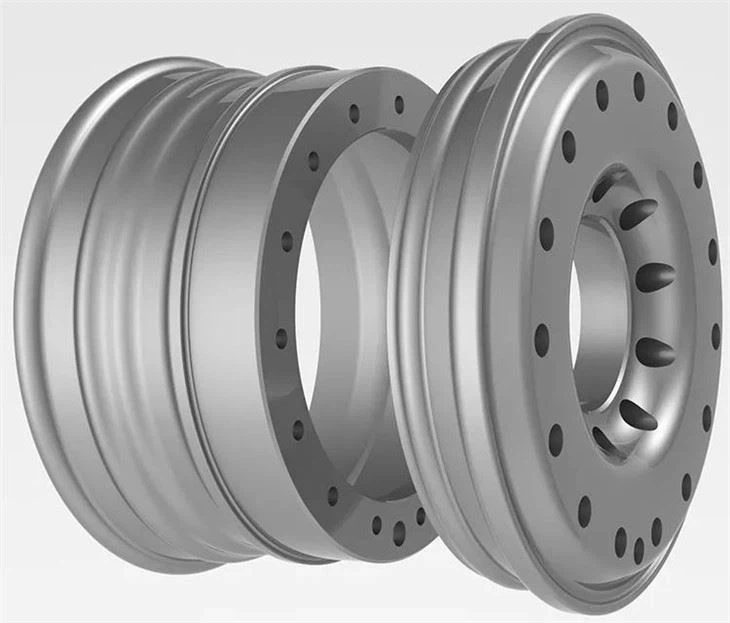
Where a billet starts, how much of it survives machining, why the term describes two different production routes, and how to specify one without paying for capability the vehicle will never use.
Billet forged wheels begin life as a solid block of aluminium rather than as a casting or a pressed preform. A billet is a semi-finished product, usually extruded or continuously cast and then homogenised, supplied in round bar or plate form with a certified chemistry and a known grain direction. Everything about the finished wheel is decided by what is cut away from that block.
The term is used loosely in the market, and the looseness costs buyers money. A wheel machined entirely from a billet on a five-axis centre is often called a billet forged wheel even though no press was involved. A wheel that is pressed from a billet into a rough form and then machined is a genuinely forged part. Both start from the same raw material; the difference is whether the grain structure is deformed and aligned or simply cut through.
This article separates the two routes, explains how material grade and billet quality affect the finished part, describes what the machining sequence can and cannot produce, and sets out how a buyer should specify a billet-based wheel for a custom programme without overpaying for a structural capability that only matters in competition.
What a Billet Is and Why Its Quality Matters
An aluminium billet for wheel production is typically supplied as extruded round bar in 6061 or 7075, in diameters matched to the largest section of the intended wheel. The extrusion process produces a directional grain along the bar axis, and the material is homogenised afterwards to even out alloying element distribution and reduce internal stress.
Billet quality is not a single number. It covers chemistry within specification, hydrogen content that governs porosity, internal soundness verified by ultrasonic inspection, and dimensional tolerance on diameter and straightness. A cheap billet with poor internal soundness will produce a wheel that machines beautifully and fails unexpectedly, because the defect was inside the material from the start.
Grain direction is the second quality factor. In an extruded bar the grain runs lengthwise, which is convenient for a wheel because the axial direction carries much of the bending load in the barrel. A shop that cuts blanks across the bar instead of along it loses that alignment, and the loss is invisible in the finished part.
For a buyer, the useful question is not which alloy is used but which mill certificate accompanies it and whether the billet was ultrasonically inspected before machining. A supplier who can show a certificate with a heat number that matches the parts in the crate is operating a traceable process; one who cannot is asking the buyer to accept an assumption.
The Two Production Routes Behind the Same Name
The first route is press forging. The billet is cut to a calculated weight, heated into the forging window for the alloy, and pressed between dies that rough-form the wheel. The deformation closes internal porosity and produces a grain flow that follows the die contour. The part then goes through heat treatment and machining, with relatively little material removed from the structural sections.
The second route is machining from solid. The billet is clamped on a five-axis centre and the wheel is cut out of it, with no intermediate forming step. This is what most products sold as billet wheels actually are. It offers complete design freedom because there is no die, and it produces a part with uniform, predictable material properties taken from the parent billet.
The difference in behaviour is subtle but real. A pressed forging has grain flow that turns through the spoke-to-barrel transition, which improves fatigue resistance at that corner. A machined-from-solid part has grain flow that runs straight through and is interrupted by the cut, so the same corner relies more on geometry and surface finish than on material orientation.
Neither route is dishonest, and both can produce an excellent wheel. The problem is a specification that pays forging prices for a machined part, or expects forging fatigue performance from a part that was never pressed. A buyer should ask directly which route the quotation describes, and expect a straight answer with a process sheet behind it.
| Stage | Press Route | Machined Route |
|---|---|---|
| Starting stock | Billet cut to calculated weight | Billet sized to the finished envelope |
| Forming | Heated and pressed in dies | No forming step |
| Grain structure | Follows the die contour | Straight through, cut at the spoke transitions |
| Material removed | Moderate, mostly finishing allowance | High, often the majority of the billet |
| Tooling investment | Dies required per design | None beyond programming |
| Design freedom | Limited by die geometry and press capacity | Very high, including one-off shapes |
| Economic batch | Medium to large | Small, including single sets |
Material Selection for Billet Forged Wheels
6061 in the T6 condition is the default for road wheels. It machines predictably, anodises evenly, welds if a repair is ever attempted, and provides a comfortable margin between yield and fracture. For a wheel that will see kerbs, winter salt and years of use, that margin is worth more than a higher strength figure.
7075 is chosen when mass is the dominant constraint. Its strength allows thinner spokes and a lighter face for the same load, and in a machined-from-solid part the absence of forging flow makes that extra strength more valuable because the geometry has to do all the fatigue work. The cost is a narrower process window in machining and a finish that demands more care.
A third option is a modified 6061 chemistry with tighter impurity limits, sometimes specified for large-diameter wheels where internal soundness matters most. The difference is not visible in a datasheet headline but shows up in ultrasonic inspection results and in the consistency of anodised colour across a batch.
Alloy selection should follow the load case, not the price list. A 22-inch wheel for a heavy electric SUV needs section thickness that makes 7075 unnecessary, while a 19-inch competition wheel for a light coupe can use the higher grade to remove mass where it matters most. Our production runs both alloys for that reason, and the choice is made per programme.
CNC Machining: Where the Design Is Decided
Machining a wheel from billet is a sequence of roughing and finishing operations on a five-axis centre. Roughing removes the bulk of the material quickly with a large cutter, leaving an allowance for finishing. Finishing then produces the final surface, the spoke windows, the bead seats, the hub face and the bolt holes, each with its own tolerance and surface requirement.
The order of operations matters because each cut releases stress from the billet. A part roughed on one side and finished on the other can move between operations, which shows up as runout or as a wall thickness that varies around the circumference. Experienced programmers sequence the cuts to balance material removal and to keep the part supported, and they leave a stress-relief pause where the geometry demands it.
Surface finish on the spoke is not cosmetic only. A finish cut with a worn tool leaves a smeared layer with residual tensile stress, which is exactly where a fatigue crack initiates. The visible symptom is a dull patch that will not polish out; the functional symptom appears years later. Tool life management is therefore a quality control measure, not a cost measure.
Tolerance on the hub face and the centre bore decides how the wheel sits on the vehicle. A hub face that is not flat within specification produces a wheel that tightens unevenly and runs out despite a perfect balance. That is why a machined wheel should be checked on a surface plate as well as on a balancer, and why the inspection record should include hub face flatness rather than only runout.
What machining from billet genuinely buys a buyer:
- Any spoke geometry, window shape or concave depth without a die investment
- Single-set orders and one-off designs at a commercially sensible quantity
- Rapid iteration when a fitment or styling change arrives mid-programme
What the Process Costs in Material and Time
A machined wheel can consume a substantial share of its billet as chips. On a deep concave design with large windows the removed fraction can exceed the finished weight several times over, and that material has to be bought, stored, cut, transported as swarf and recycled at a fraction of its purchase value. This is the hidden cost that makes machined wheels expensive at low volume and competitive at high volume only when the design cannot be pressed.
Machine time is the second cost. A single wheel can occupy a five-axis centre for many hours across roughing and finishing, and that time is priced into every quotation whether or not the buyer sees it as a line item. A design with deep pockets, sharp internal corners and fine surface detail takes longer than a simple five-spoke, which is why two visually similar wheels can differ substantially in price.
Press forging changes that equation. Once a die exists, each part consumes far less machine time and far less material, so the cost per unit falls sharply with volume. The die cost has to be amortised, which is why a forged programme makes sense from a few dozen sets upward and a machined programme makes sense below that threshold.
Buyers should treat the route as a function of volume and design stability. If the design will change every season, machining is the only rational choice because no die is stranded. If the design is fixed and the volume is growing, moving to a forging tool pays back over a predictable number of sets, and the conversation with the factory should start well before that point is reached.
Custom Design Without a Die
The absence of a die is the defining commercial advantage of the machined route. A brand can commission a spoke pattern, a window shape and a concave profile that exist nowhere else, in a quantity as small as one set, and revise it after seeing the first article on a vehicle. That iteration loop is impossible with a forging tool, where every change means a new die.
The limits are structural rather than tooling-based. Spoke thickness has to satisfy the load case, the hub has to carry the bolt pattern without distorting, and the barrel has to clear the brake package. Inside those limits the designer is free, which is why billet-based wheels dominate the bespoke segment where a customer wants a specific look for a specific car.
Finish freedom follows the same logic. A machined face, a brushed surface, a polished lip, a two-tone anodised treatment or a painted centre with a diamond-cut edge are all available on the same part because the geometry does not depend on a die's surface. Our forged wheel customization service treats design and finish as separate decisions, which keeps a colour change from triggering an engineering review.
For brands building a first catalogue, the practical sequence is to prove the design on a machined part, sell it, and only then invest in tooling for the versions that sell best. That approach keeps capital tied to proven shapes and leaves the experimental work in a process that can absorb change.
Billet Wheels in Bespoke and Motorsport Work
The bespoke segment is where billet forged wheels have their clearest commercial case. A customer wants a wheel that matches a specific car, a specific colour and a specific stance, and there is no volume to justify a die. Machining delivers exactly that part, and the brand can show the customer a rendering, cut one set, and adjust before committing to a catalogue.
Motorsport uses the route for a different reason: change frequency. A team may revise a spoke or a window between events, and a die would be obsolete before it paid for itself. A machined part can be reprogrammed in days, and the same billet stock serves every revision, which keeps a race programme responsive without a tooling inventory.
Vehicle display and show work is a third niche. A concept car or a show stand needs a wheel that photographs well and fits a body that will never be produced. Machining is the only sensible answer, and the part can be finished to a standard that would be wasteful on a road wheel because it will never see a kerb.
The common thread is that none of these applications depend on the last few percent of fatigue performance at the spoke root. They depend on shape freedom, speed of change and small quantity. When a programme moves from any of those niches into regular production, the economics reverse and a forged tool becomes the better answer.
- Bespoke one-off sets, where the design exists for a single vehicle and a single owner.
- Prototype and development wheels, where the geometry is expected to change after the first test.
- Motorsport revisions, where a new window shape has to be available before the next event.
- Display and concept builds, where appearance and fitment matter and service life does not.
Quality Control for Billet Forged Wheels
Incoming material inspection is the first gate. The mill certificate is checked against the purchase specification, the heat number is recorded, and a sample is tested for hardness before any cutting begins. A supplier who skips this step has no way to separate a good billet from a marginal one until the finished wheel fails.
In-process inspection covers wall thickness at defined points, spoke thickness, and the depth of the concave surface. Ultrasonic thickness measurement is fast and non-destructive, and it catches the programming error that leaves a section too thin long before the wheel reaches a load test.
Final inspection covers runout at the bead seat and the lip, dynamic balance in two planes, hub face flatness, bolt hole position and centre bore tolerance. Each of those items maps to a specific complaint a customer might raise, which is why the record is more useful than a single pass or fail stamp.
Destructive testing closes the loop. A wheel from each batch or each significant design change should go through radial fatigue, cornering fatigue and impact testing at the rated load, with the results retained against the design revision. That archive is what allows a supplier to answer a technical question two years after the batch shipped.
Documentation should follow the part, not the order. A serial number engraved on the hub that links back to the billet heat number, the machining programme revision and the inspection record turns a wheel into a traceable object. For a machined product where every part is nominally unique, that linkage is the only way to investigate a complaint without scrapping the whole batch.
How RETA Produces Billet-Based Wheels
RETA has built forged wheels in Ningbo since 2012, with the company founded in 2009, a 12,000 square metre plant and more than 100 staff. Machined-from-billet work and press-forged programmes run in the same facility, so a buyer can move between the two routes as volume and design stability change without changing supplier.
The quality system covers ISO 9001, ISO 14001, ISO 45001 and IATF 16949, with national high-tech enterprise status granted in 2021. Internal limits are held tighter than the SAE, JWL and PCT sequences we design to, and 30-degree and 90-degree impact and deformation tests are added because a billet wheel's real risks appear at angles a single radial test does not cover.
Commercially, the minimum order is one set of four, standard sizes run in roughly 7 to 15 working days and fully custom designs take about 25 to 35 working days. Programmes that need a private shape usually start from the MMX 1P series as a reference for proportions before a new geometry is programmed.
We exhibit at SEMA, where the brand received the 2023 Best Innovative Wheel Brand Award, and the RETA custom forged wheel line is where most bespoke conversations begin. Those conversations are usually about a wheel for one specific vehicle, which is exactly the segment where the machined route makes commercial sense.
Frequently Asked Questions
Q1. Are billet wheels the same as forged wheels?
Not necessarily. Both start from a billet, but only one is pressed into shape. A wheel machined entirely from solid billet is a machined wheel with forged-grade raw material, while a press-forged wheel has a deformed grain structure that follows the part. Buyers should ask which process the quotation describes.
Q2. Is a machined-from-billet wheel weaker than a forged one?
It has less grain-flow advantage at the spoke-to-barrel transition, so the design has to compensate with geometry and surface finish. A well-designed machined wheel passes the same load and fatigue standards, which is why the route is accepted for road use when the engineering is done properly.
Q3. Why are machined wheels more expensive per unit at low volume?
Because a large share of the billet becomes swarf and each wheel occupies a five-axis centre for hours. Those costs are unavoidable without a die, which is why machining suits small volumes and one-off designs while forging suits stable designs at higher volume.
Q4. Can any design be produced from billet?
Any design that fits inside the starting billet and satisfies the load case can be machined, including shapes that would be impossible to press. The practical limits are billet diameter, tool reach inside the windows and the structural thickness required at the spoke root.
Q5. Which billet grade should a road wheel use?
6061-T6 is the sensible default for road use because it balances strength, toughness, corrosion resistance and finish consistency. 7075 becomes relevant when mass is the dominant constraint and the vehicle is inspected regularly, as in competition use.
Send us your design intent, volume and load case, and we will tell you whether billet forged wheels should be machined or pressed, with the material route and tooling boundary stated before the first cut.
View One-Piece Wheels Request a Process Review